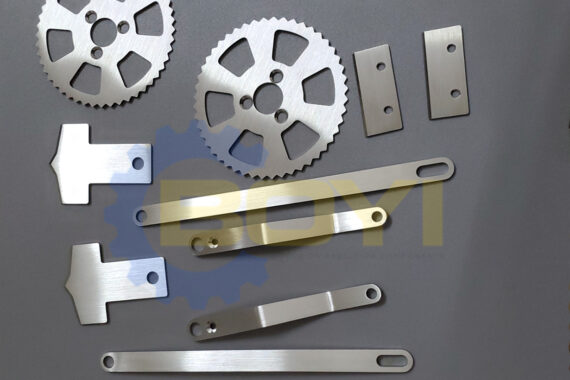
While often associated with aerospace or medical devices, CNC machining components are equally vital...

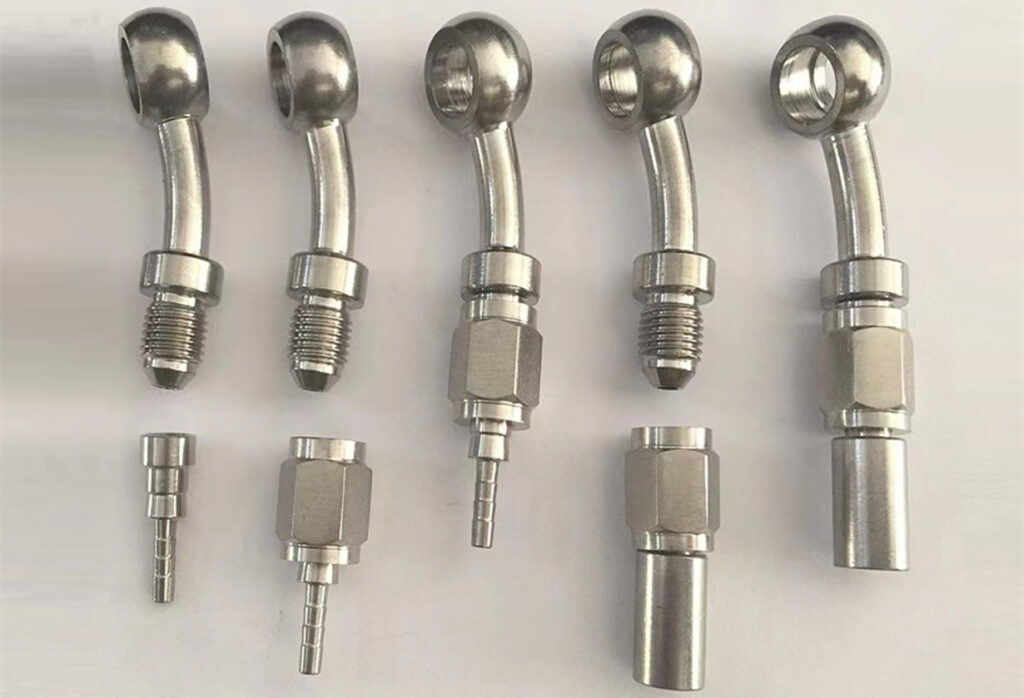
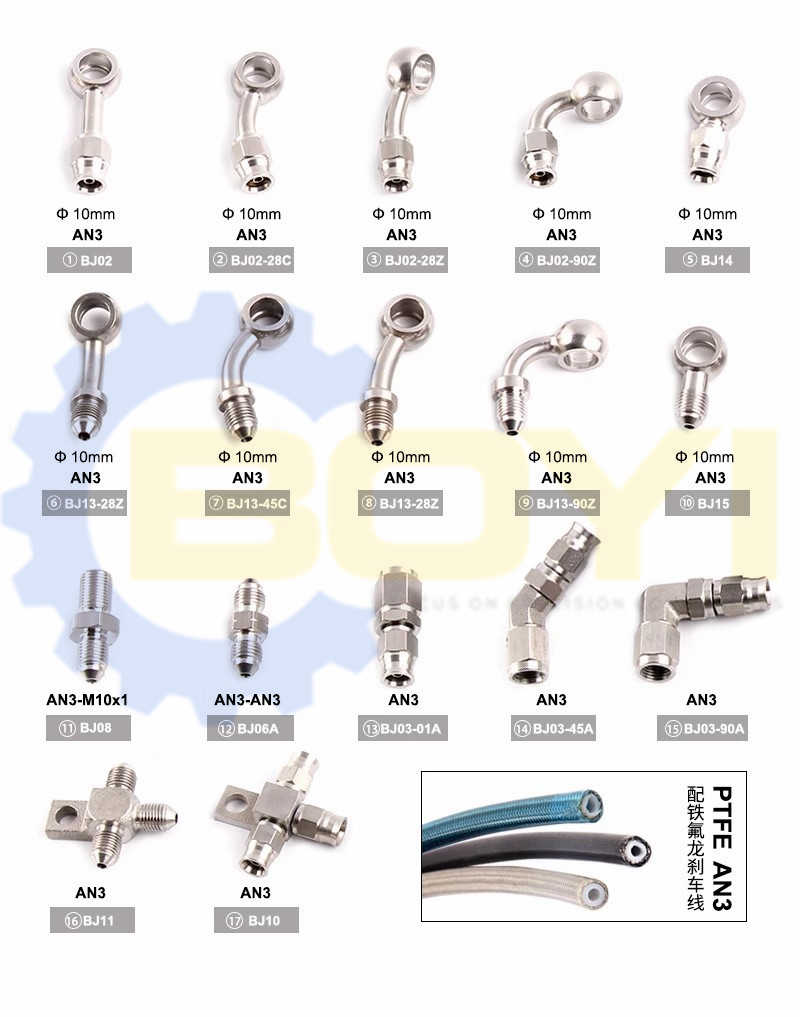
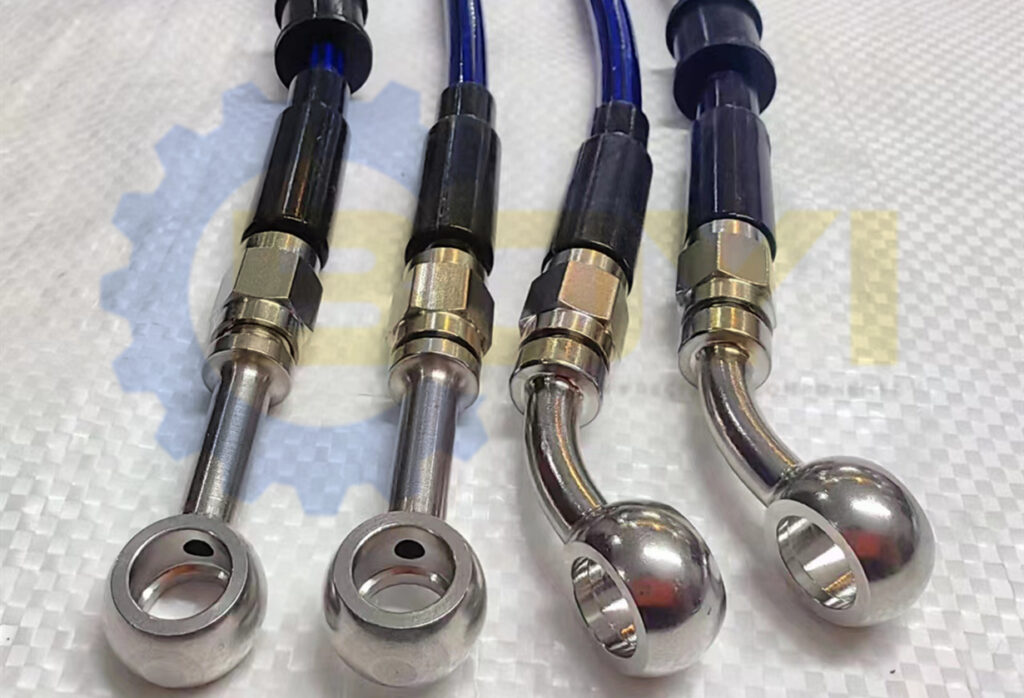
We manufacture high-quality brake hose fittings using our CNC turning and milling shops. Whether it’s anodized aluminum, stainless steel, or chrome-plated steel adapter fitting, our engineers are skilled at producing these Banjo brake adapter fitting, and we have ample stock of standard sizes. Check Catalog Now
What is a Banjo Brake Adapter?
At its core, a banjo brake adapter is a small, shaped fitting that changes the angle at which your brake hose connects to the caliper or master cylinder. It consists of two main parts:
- The Adapter Body: This bolts directly into the caliper/master cylinder port. It has a hollow passage for brake fluid and a new, angled outlet port.
- The Banjo Bolt: This special bolt passes through a hole in your brake hose’s banjo fitting, securing the hose to the adapter and creating a tight, sealed connection.
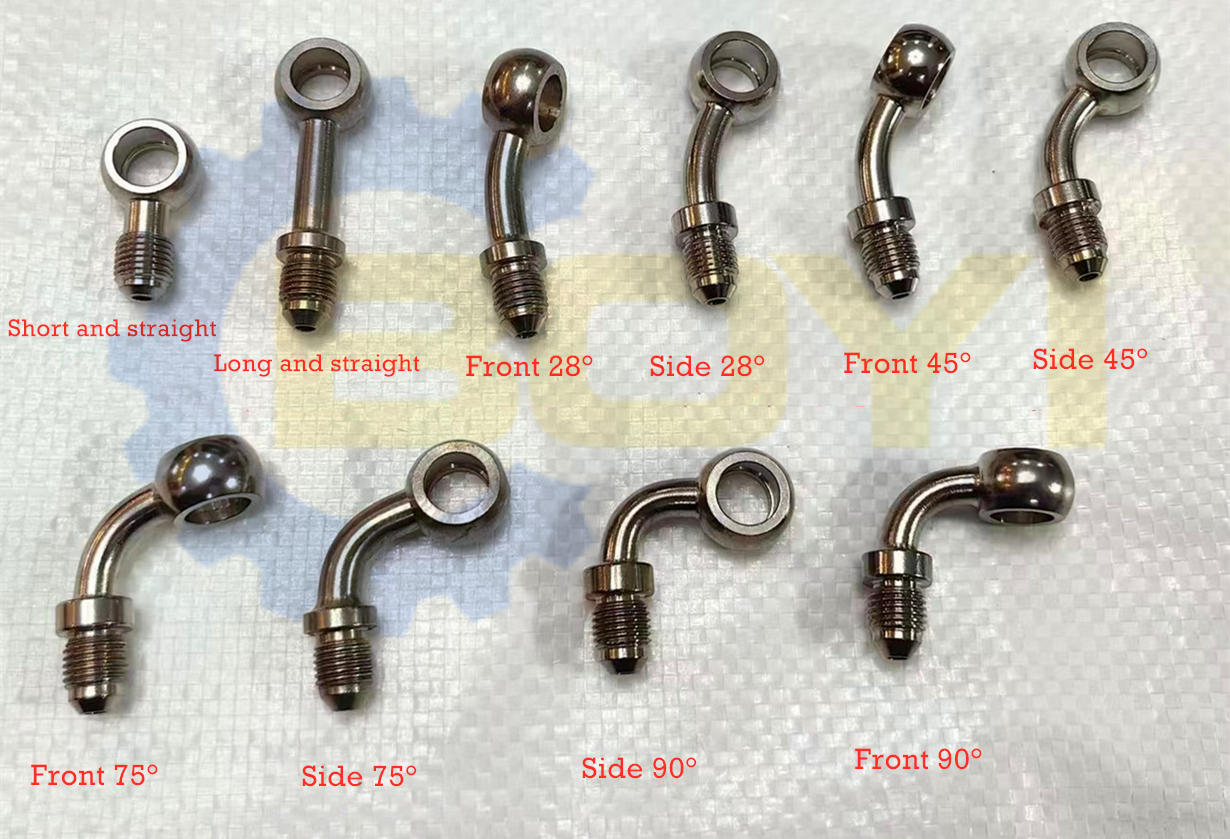
They come in a variety of angles (e.g., 10°, 28°, 30°, 45°, 75°, 90°) and orientations (left, right, up, down) to solve almost any clearance or routing issue you might encounter.
Why Would You Need One?
There are several scenarios where a banjo adapter is not just useful, but essential:
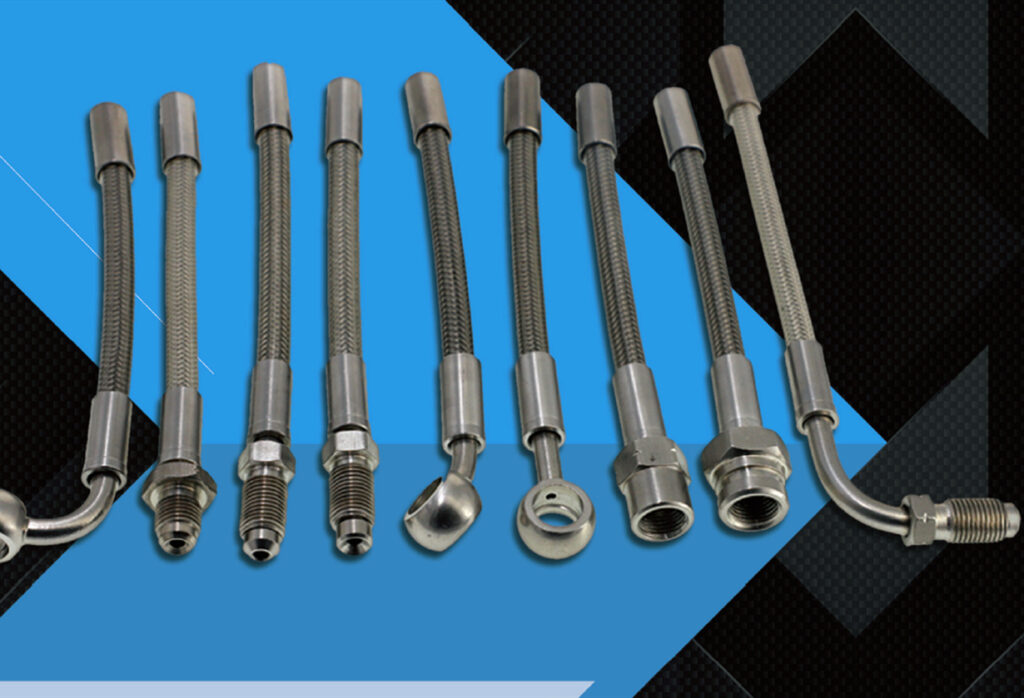
- Handlebar Upgrades: Changing to clubman, clip-on, or ape hanger bars often requires re-routing brake lines, necessitating a new connection angle.
- Caliper Clearance: On some custom setups or swingarm swaps, the brake line might interfere with the suspension, wheel, or frame without an adapter.
- Clean Routing: For a show-quality build, you want the brake lines to follow smooth, intentional paths. Adapters help eliminate awkward kinks and bends.
- Converting Thread Types: Some adapters can also convert between different thread pitches (e.g., metric to AN), though this is less common.
CNC Machining for Banjo Brake Adapter
- Unmatched Strength and Integrity: CNC machining starts with a solid billet of high-grade material (typically 6061 or 7075 aluminum, or sometimes stainless steel). Unlike casting, which can introduce internal voids or inconsistencies, a machined part has a continuous grain structure, resulting in superior strength and reliability.
- Precision to Perfection: Brake systems are unforgiving of leaks. CNC machines create threads, sealing surfaces, and fluid passages with microscopic accuracy. This ensures a perfect seal with the crush washers, preventing fluid loss and dangerous brake failure.
- Ultimate Customization: Need a 37-degree angle with a left-hand thread for a one-off custom build? No problem. CNC programming can be modified to create any geometry imaginable, solving unique clearance issues that off-the-shelf parts can’t.
- Superior Surface Finish: A CNC-machined part can be finished to a beautiful, aesthetic standard—whether it’s a raw machined look, a bead-blasted texture, or a brilliant anodized color—all while maintaining critical tolerances.
CNC Machining Processing Brake Hose Fitting
Creating a banjo brake adapter is a symphony of digital design and mechanical precision. Here’s how it’s done:
Digital Blueprinting (CAD)
- It all starts on a computer. Using Computer-Aided Design (CAD) software, an engineer designs the adapter in 3D. Every dimension is critical:
- Thread Specifications: The male threads that screw into the caliper and the female threads for the banjo bolt must be perfect (e.g., M10x1.0, 3/8-24 UNF).
- Fluid Passage Diameter: The internal channel must be precisely sized to maintain fluid flow without creating a weak point.
- Angles and Orientation: The angle of the banjo bolt outlet is calculated to the exact degree.
Toolpath Programming (CAM)
Once the design is finalized, the CAD model is imported into Computer-Aided Manufacturing (CAM) software. This program translates the 3D model into a set of instructions (G-code) that the CNC machine will follow. It determines the cutting tools, spindle speeds, feed rates, and toolpaths needed to create the part.
The Machining Operation
A solid block of aircraft-grade aluminum is securely clamped into the CNC mill. The machine then uses a series of specialized tools to sculpt the part:
- Drilling: A drill bit creates the initial internal fluid passage.
- Tapping: A tap tool cuts the precise threads into the ports.
- Milling: End mills cut the external profile, shape the hex flats, and machine the specific angle of the adapter body.
- Boring: A boring bar may be used to achieve a perfectly smooth and dimensionally accurate fluid passage.
This process is often completed in a single setup on a modern 3-axis or 5-axis CNC mill, ensuring perfect alignment between all features.
Deburring and Finishing
After machining, the part is carefully removed from the machine. Any sharp edges or microscopic burrs left from the cutting process are meticulously removed by hand. This ensures clean threads and perfect sealing surfaces.
Quality Control
This is the non-negotiable final step. Every single adapter must be inspected. Critical checks include:
- Thread Gaging: Verifying that both sets of threads are to the correct specification and class of fit.
- Pressure Testing: Many manufacturers pressure test a sample from each batch to ensure they can hold well beyond the operating pressure of a brake system without leaking or failing.
- Dimensional Inspection: Using calipers, micrometers, and sometimes Coordinate Measuring Machines (CMM) to confirm every dimension is within tolerance.
Surface Treatment (Optional)
For corrosion resistance and aesthetics, parts are often anodized. This hard, durable electrochemical process can add a layer of protection (clear anodize) or a splash of color (red, blue, black, etc.). The anodizing process must be carefully controlled to avoid building up material on the critical threads, which often need to be masked or chased post-anodizing.